
Searching Carroll County Criminal Dockets
For most people, Indiana MyCase is the quickest route into Carroll County criminal dockets. It pulls Odyssey courts into one statewide search form. Pick Case when you already have a case, citation, or cross-reference number. Pick Name when all you know is a party. Set the court filter to Carroll County. Choose Criminal & Citation to trim the case types. Remember that MyCase is a convenience display, not the official record.
A precise number beats a broad name every time. Name searches can drag in unrelated cases. The official search caps how many results it returns. Before you open the CCS timeline, confirm the court and the filing date. Check the case type and each party's role too. If an entry you expect is missing, call or visit the Carroll County Clerk. You can also mail a request that names the court, the case number, the date range, and the document you want. Clerk staff can explain copy formats. They cannot give legal advice.
- Open MyCase and choose Case or Name.
- Select Carroll County and a criminal limit when useful.
- Enter one case, citation, or cross-reference number, or supply the party name.
- Match the result by court, type, file date, and role.
- Read the CCS and ask the clerk for an official or certified copy.
Carroll Criminal Number Codes
Carroll County carries county number 08, and its Circuit Court uses 08C01. A number like 08C01-YYMM-F6-###### is purely a format example. It splits into county and court, filing year and month, case type, and sequence. MyCase will accept a number with the hyphens and leading zeroes stripped out. Keep the displayed form anyway, since a clerk request goes more smoothly with it.
F1 through F6 mark the current felony levels. CM stands for criminal misdemeanor, and MR for murder. IF is an infraction, while OV is a local ordinance violation. Older criminal and felony categories appear as CF and FA through FD.
These labels trace back to Indiana Administrative Rule 8. A code names the filing category and nothing more. It is not a result, and it is not proof that any allegation held up.
Inside a Carroll County Criminal Docket
A Carroll County criminal Case Summary stacks several blocks on one screen. The header names the court and the case type. It also gives the file date, the status, and any related cases. Party and attorney fields may carry role details or removal notes. Charges and bonds sit apart from the CCS. The CCS is Indiana's chronological register of filings and court events. Read the latest entry next to the charge and disposition fields. That keeps a filed allegation from being mistaken for a final judgment.
| Case header | Case style, number, court, type, flags, file date, and status. |
|---|---|
| Charges | Charge number, offense description, statute, degree, citation, and filed-as level. |
| Bonds | Posted date, type, amount, number, status date, and status when public. |
| CCS events | Event date, description, comments, hearing result, canceled marker, and document links. |
| Disposition | Reason, charge, judicial officer, sentence terms, conditions, and judgment references. |
| Financial area | Balance date, charges, credits, payments, and transactions where published. |
A document icon promises nothing. Sensitive attachments, mental-health material, sealed documents, and other excluded records can stay hidden even when the CCS says a filing happened.
Carroll Charges Are Allegations
The charge block tells you what was filed, nothing else. It may list the statute and the degree. It may also show the offense date, a modification, and the level at filing. None of those fields settles the outcome. A charge can be amended, dismissed, merged, or resolved by plea or trial later on. For those later acts, turn to the CCS and the sentencing or disposition section.
Read the sequence. Check the filed-as charge, each amendment, the plea or trial entry, and the final disposition before describing a Carroll County criminal case.
Treat status labels with the same care. Closed means no current open activity, not any particular outcome. Canceled describes one event or hearing, not dismissal of the whole case. When the online wording confuses you, keep the case number and event date, and ask the Carroll County Clerk for the order behind the entry.
How a Criminal Case Moves
A criminal docket fills in as papers and court actions get entered. The sequence starts with a filing. An arraignment records the first formal setting. Pretrial entries may cover counsel, discovery, bond, motions, and future dates. A plea or trial entry precedes disposition. Sentencing can then add confinement, credit, suspended terms, conditions, fees, or awards. Not every case hits each step. One reset can add several entries without resolving the charge.
Docket flow: Charge Filed › Arraignment › Pretrial Settings › Plea or Trial › Disposition › Sentencing
Carroll's current local rules also set automatic criminal discovery timing. The State's disclosure is due within 30 days after appearance, and the defense response is due within 30 days after that disclosure, subject to the rule and the facts of the case. A docket may show those filings. Court staff still cannot tell a self-represented party what to file.
Carroll Bond Entries Need Context
Carroll County's local rule publishes a bond schedule. Level 1 sits at $100,000 with ten percent cash permitted. The amounts then drop to $75,000 for Level 2, $50,000 for Level 3, $25,000 for Level 4, $10,000 for Level 5, and $5,000 for Level 6. Exceptions, release conditions, and timing provisions fill out the rule too. Treat it as context for reading the docket, never as a prediction of release.
The MyCase bond block can list a posted date, type, amount, number, and status. Weigh those fields against the latest order. A schedule amount never overrides a case-specific ruling. A bond entry says nothing about guilt. When the difference matters, consult the current Carroll local rules along with the court's order.
Courts That Hold Criminal Dockets
Carroll County keeps its criminal docket mainly in Circuit Court. Murder cases, felonies, misdemeanors, infractions, and ordinance violations all land there. So do protective orders, mental-health matters, and miscellaneous cases. Carroll Superior Court deals mostly with civil, family, probate, and small claims work. Some juvenile and quasi-criminal matters cross its desk too. The case header at the top of any filing tells you which court holds the record.
Delphi City Court still shows an Odyssey identifier. An official Delphi record described it as inactive after a judicial vacancy in 2025. A city ordinance search may need routing confirmed first. Federal charges live elsewhere entirely. They never appear in MyCase; that means PACER and the U.S. District Court for the Northern District of Indiana.
Carroll Criminal Docket Copies
Seeing a document listed on the Carroll County criminal docket is not the same as being able to open it. Sentencing orders are often online in many Indiana criminal case types, per the state's document matrix. Other non-confidential filings may still need an in-person request. So a docket entry for a probable-cause filing, an exhibit, or a transcript tells you it exists. MyCase may not show the pages themselves.
Wanting a copy? Gather a few things first. You will need the court, Carroll Circuit Court, plus the formatted case number and the exact CCS event and date. Decide whether an ordinary copy will do or a certified one is required. Then reach the County Clerk by phone, at the third-floor counter, or in writing. The counter is at 101 W. Main Street in Delphi. Transcripts belong to the court reporter, not the clerk. Older or converted files may need direct clerk help too. Indiana law allows inspection and copying of public records. Exclusions, fees, and reasonable identification still apply.
Case-number formats are set by the official Indiana case-number rules.
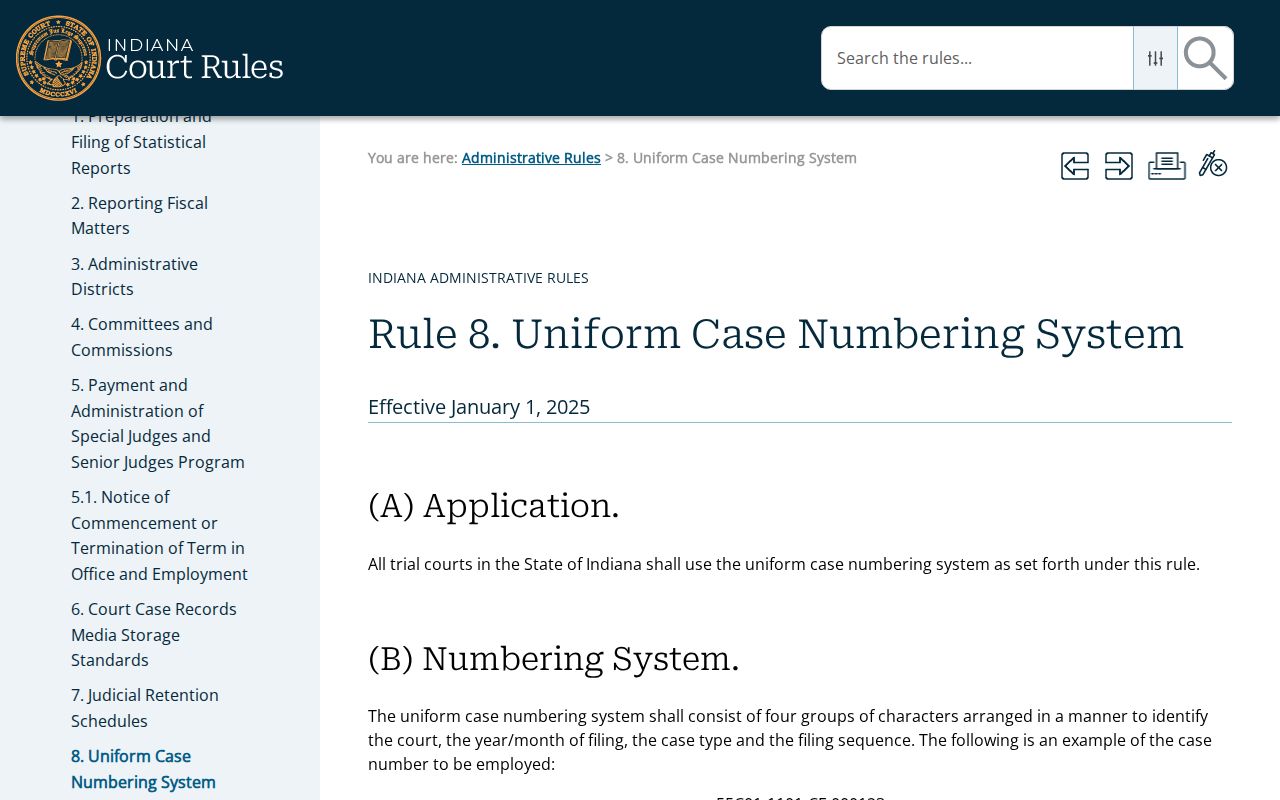
Those rules lay out the county, court, filing date, case-type, and sequence parts of a case number. Read them and any Carroll criminal docket identifier becomes easy to parse.
Sealed Dockets and Public Access
Indiana's Rules on Access to Court Records start from the opposite place: a Court Record is public unless a rule excludes it. MyCase is only a convenience display. Confidential, sealed, expunged, juvenile, mental-health, medical, pretrial, and protected information can be missing or redacted from what you see. Parties sometimes get access the public does not. And a missing document never proves that no filing exists.
Key rules:
Access Rule 4 states the public-access presumption.
Access Rule 5 identifies excluded, confidential, sealed, and redacted material.
Access Rule 9 supplies a limited process for seeking access to an excluded record.
A request under Indiana Code section 5-14-3 cannot override a sealing order or confidentiality rule. Ask the clerk which rule controls and what route applies. For routine verification, trust the originating court and clerk over any copied online summary.
Canceled Carroll Criminal Hearings
A hearing row in the Carroll County criminal docket may show a canceled marker. It may also show a result, a comment, or a cancellation reason. Check the Indiana Court Calendar for a near-term setting. Then compare it against the newest CCS entries. Keep the limits in mind: the public calendar only reaches seven days back and four weeks ahead. So it cannot give you a full criminal event history.
When a hearing appears in one system but not the other, contact Carroll Circuit Court. A cancellation does not close the charge. A later reset, plea, trial, disposition, or sentencing entry may control the outcome. The court can confirm the setting. The clerk can hand you the official order or docket record tied to the change.