
Searching the Camden Court Docket
Start with the official MyCase portal and pick Carroll County from the court selector. Camden itself has no court option there. A full case number is your best search term. MyCase will also take a citation number or cross reference through the Case tab. The Name tab handles person or organization lookups. Only one of those per query. Filter by court, case category, status, or filing range only when you already know that detail.
When a result opens, check the court, file date, case type, and party role. Do not assume it is the right case before that. The Chronological Case Summary, or CCS, is the event timeline for the docket. It can list filings, service, motions, settings, orders, cancellations, and disposition. Read the newest entry before concluding anything. A case title or status alone will not tell you the whole story.
- Read the named court and identifier from the source paper.
- Choose Case or Name in MyCase.
- Select Carroll County, not Delphi City Court.
- Match the number, type, date, and party role.
- Confirm a vital date with the court.
Camden Has No Court Selector
A town name can say where something happened. It does not name the court that received the filing. MyCase and the Court Calendar expose only Carroll County trial courts, never a Camden court. Delphi City Court looks tempting as the lone municipal option. Resist picking it on that basis alone. Match the court name, issuing agency, citation, or cause number instead.
Carroll cause numbers open with county code 08. Within that, the group 08C01 marks Circuit Court and 08D01 marks Superior Court. Case-type codes follow and describe the filing category. These codes steer a Camden docket search far better. A party's street address never will.
Camden Municipal Court Basics
Camden has no separate municipal court. Under Carroll County's local assignments, Circuit Court carries the main criminal, infraction, ordinance, protection-order, and mental-health docket. Superior Court carries much of the civil, small-claims, family, probate, guardianship, adoption, and juvenile docket. Both sit at the county courthouse in Delphi.
Camden Town Hall still holds town records. That role does not make it a court clerk. An ordinance, meeting record, or local administrative item stays with the town until a judicial filing turns it into a court case. Ask which body created a document before requesting a copy.
Camden Transparency Portal
Camden offers one useful local distinction: the town runs an official transparency portal for municipal public records and town government material. It cannot replace MyCase, the Indiana Court Calendar, or the Carroll County Clerk when you need a filed case from the court docket. The portal's own page displays the town's published records.
The separation matters because "public record" reaches beyond court records. Each office can answer only for the files it keeps.
Court Dates and Settings in Camden
The Indiana Court Calendar posts the public schedule for Carroll Circuit and Superior courts. Choose Carroll County. Then pick the court named on your notice. A result can show the session date, start and end time, public case number and style. It also lists the hearing description, judicial officer, location, time zone, and a MyCase link.
Look back only seven days and ahead only four weeks there. That is a calendar, not the full Camden case register. Open MyCase and read the latest CCS event. Look for a reset, a canceled marker, a comment, or a result. If the two systems disagree, call the court.
| Date | The published session date. |
|---|---|
| Time | The stated start and end time. |
| Courtroom | The county court location field. |
| Judge | The listed judicial officer. |
| Setting Type | The hearing description. |
Camden Town Hall Route
Camden Town Hall sits at 153 W. Main Street, phone (574) 686-2121. Use that number for a council item or ordinance. It also covers an administrative record or a transparency request. Give staff the subject, date range, department, and document you want. They can find the file fast that way.
County court records go to Carroll County Clerk Sharon Milburn. Her office is at 101 W. Main St., Suite 206, Delphi, phone (765) 564-4485. Say whether you want inspection, an ordinary copy, or a certified copy. Transcripts belong with the court reporter. This split keeps the town's channel useful. It does not push any county clerk work onto the town channel. The state's official Carroll municipal resources page lists these local contacts.
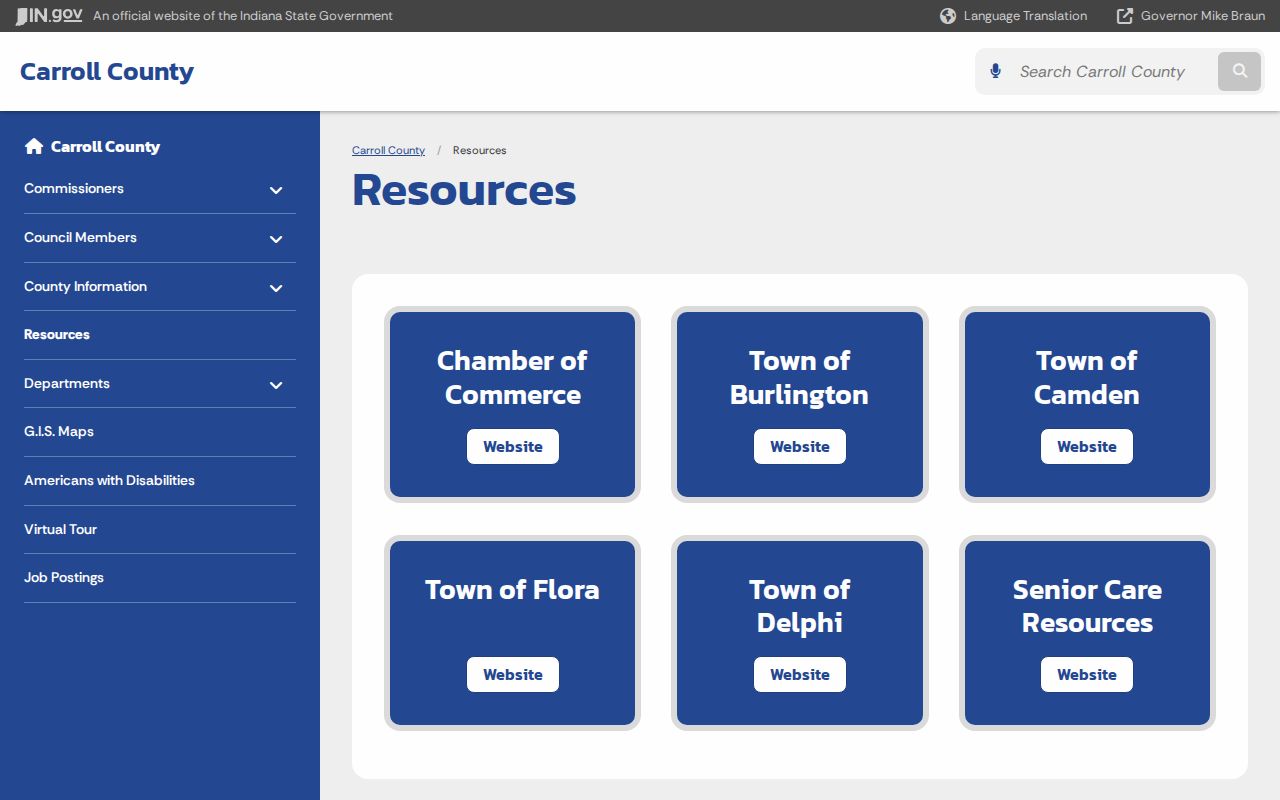
The state page backs the municipal route for town items.
Traffic Tickets in Camden
Take the UTT number from a Camden citation into MyCase or Indiana ePay. ePay also searches by driver's license. Or use a name and birth date. The Carroll clerk says a new citation may take three to five business days to appear. Wait that period before searching. No result before then is not proof of dismissal.
Not every ticket can be paid online. If MyCase lists no fine, the clerk says appear in person. Online payment may offer an Admit or Nolo Contendere option. It comes with a judgment and waiver acknowledgment. Read the county's traffic ticket details before picking a plea or payment path.
Camden Citation Number Check
A missing Camden citation is usually a search problem, not a missing case. Strip away any extra name filters and type in the ticket number alone. Confirm which agency issued it and which court it names. The clerk needs time to post new citations. Wait out that period before calling with the UTT number in hand.
Guessing at personal details rarely helps. A town portal will not hold a court ticket. Camden matters can land in Carroll Circuit Court even when the event happened in town. ePay eligibility does not follow case visibility. A file can sit in MyCase with no payment button at all. Ask the court clerk for the official current balance and any appearance requirement. Do not trust the payment screen alone.
Routing rule: Search the case number and named court first; Camden's place name is context, not a court identifier.
Where Camden Cases Go
Camden legal matters split between two Carroll courts. The subject decides which one. Criminal charges, infractions, and many ordinance filings go to Circuit under local rules. Civil, family, probate, juvenile, and small-claims cases generally go to Superior. Appeals travel elsewhere, to the Indiana Court of Appeals under a docket of its own.
Docket flow: Camden town or issuing agency › Carroll Circuit or Superior Court › Indiana Court of Appeals
Federal cases live outside this system entirely. They run through PACER and the Northern District of Indiana, not MyCase, so know which system holds your case before typing in a name and reading "no record" as the answer.
Camden Records Side by Side
Camden's transparency portal answers a different question than Indiana's court portals. The town source documents local government action, while MyCase documents a filed judicial case, the calendar shows a near-term public hearing, and ePay handles a qualifying ticket. None of them stands in for the rest.
| Need | Official route | Useful detail |
|---|---|---|
| Town record | Camden transparency portal | Subject and date |
| Court history | MyCase or clerk | Cause number |
| Hearing | Court Calendar | Court and date |
| Ticket payment | ePay | UTT number |
Need a certified judicial copy? MyCase may help you find the file, but the clerk still finishes the job.
Camden MyCase Error Checks
When a Camden search fails, blame the form before assuming no case exists. MyCase's Case tab accepts only one identifier. That can be a case number, a citation number, or a cross reference. A first or middle name requires a last name. A business name cannot ride along with a person's last name. The filing start date must precede the end date. Any supported wildcard goes only at the end of a value that starts with a letter or number.
Loosen the search one constraint at a time. Start with the full cause number if you have it. Then try the citation or cross reference by itself. For names, enter the last name first and add the first name only if needed. A birth date can screen out a record where that field was never entered. Drop it for a broad search. The sounds-like option catches spelling variants, though it cannot confirm identity.
Very broad queries hit a results cap. Repeated attempts can trigger a captcha. If that control fails, switch to a current supported browser. Do not try to bypass the safeguard or drift to a commercial identity site. The official county search and the clerk are the right next steps. A careful Camden lookup exists to locate a known public case. Use it to follow filings or confirm a date. It is not for assembling profiles about people.
Search reset: Clear extra filters, select Carroll County, enter one valid identifier, and compare the returned court and filing date.
Camden Docket Code Clues
Indiana Rule 8 hands you useful case-type clues. The two-letter code tells you the filing category. IF is infraction and OV is ordinance violation. CM covers criminal misdemeanor, CC civil collection, SC small claims, and PO protection order. A code narrows the filing type but never states the result, so pair it with the court identifier and the newest CCS event.
Camden publishes no local code glossary of its own. If unfamiliar text appears, preserve it exactly and ask the clerk. Guessing that an abbreviation names a charge, judgment, or outcome can turn a correct case match into a misleading one.
Camden Court Record Access Rules
Indiana Access Rule 4 starts from a presumption. A court record is public unless another rule excludes it. Online access can still run narrower than what you get at the counter. Some content may be hidden or redacted. That includes sealed, expunged, juvenile, mental-health, paternity, and protection-order material. A public CCS line can even reference an attachment the public cannot open.
If access is denied, ask the maintaining clerk for the rule that controls. Rule 9 offers an extraordinary verified-request route to excluded material, not a routine copy form. Parties may gain entry through a clerk-issued code. Identity and address checks come first.
Key Rules:
Access Rule 4 states the public-access presumption.
Access Rule 5 lists excluded and redacted content.
Indiana Code chapter 5-14-3 supplies the general public-record framework.