
Getting Carroll County Court Records
MyCase is the natural first stop when you want to spot a public Carroll County case. You can also read its Chronological Case Summary, or open a document the portal allows. Searching works by case number, citation, party, organization, or attorney. Write down the court and the case number. Add the event date and the document title before you go further. Those details make any later request specific. They also help the clerk pull the right file fast.
- Search MyCase and confirm the court and case number.
- Check the CCS for the exact filing or order.
- Open any public document link that appears.
- For a missing item, contact Carroll County Clerk by phone, mail, or at the counter.
- State whether inspection, a plain copy, certification, or a transcript is required.
Mail and counter requests both go through the Carroll County Clerk. The address is 101 W. Main St., Suite 206, Delphi, IN 46923. Call (765) 564-4485 with questions. Hours vary by day. Monday, Tuesday, Thursday, and Friday run 8:00 a.m. to 5:00 p.m., and Wednesday runs 8:00 a.m. to noon. Need a transcript instead? That request belongs with the reporter for the specific court and hearing.
Carroll County Request Routing
The Indiana request guide sorts court records from everything else. A decree, will, order, or case filing starts with the county clerk. The court that keeps the file also works. Police reports and criminal-history files sit with law enforcement or the state agency in charge. A federal case is different. That one lives in PACER and the Northern District of Indiana. It does not live in the Carroll County file.
No single request reaches every product. The Indiana Court Calendar lists current public hearing settings. MyCase gives the public case display. The clerk handles available copies and certifications, while the reporter produces a transcript of spoken proceedings. Each channel answers a different question about the same docket.
| Need | First official route |
|---|---|
| Public status or CCS | MyCase/Odyssey |
| Current public hearing | Indiana Court Calendar, then court confirmation |
| Document not online | Carroll County Clerk or maintaining court |
| Certified court copy | Carroll County Clerk with exact case and item |
| Transcript | Court reporter for the hearing |
| Police report | Responsible law-enforcement agency |
Carroll County Court Record Types
Four products get mixed up constantly. The online display is the public MyCase view. It shows the case header, parties, CCS, and selected document links. An ordinary copy is just a reproduction. It comes in an available format. A certified copy carries the clerk's certification for a recipient that requires it. A transcript is different still. It is the reporter's written record of what was said in court. Keep the distinctions straight. Certification does not turn a docket summary into a transcript. And a transcript is not the filed-document set. Civil, family, probate, juvenile, criminal, infraction, and protection-order files each follow their own public-access limits. MyCase may publish an order in one case type. Yet it may require a clerk request for another non-confidential filing. A document icon can stand for one or more attachments. The icon promises nothing about whether each attachment is public or free to open. Before ordering, ask the receiving court, agency, or destination what form it needs. Certification on top of a plain copy adds needless work. An uncertified screen print where certification is required invites rejection. Let the purpose pick the product, not the portal's convenience.
Carroll County Online Is Not Official
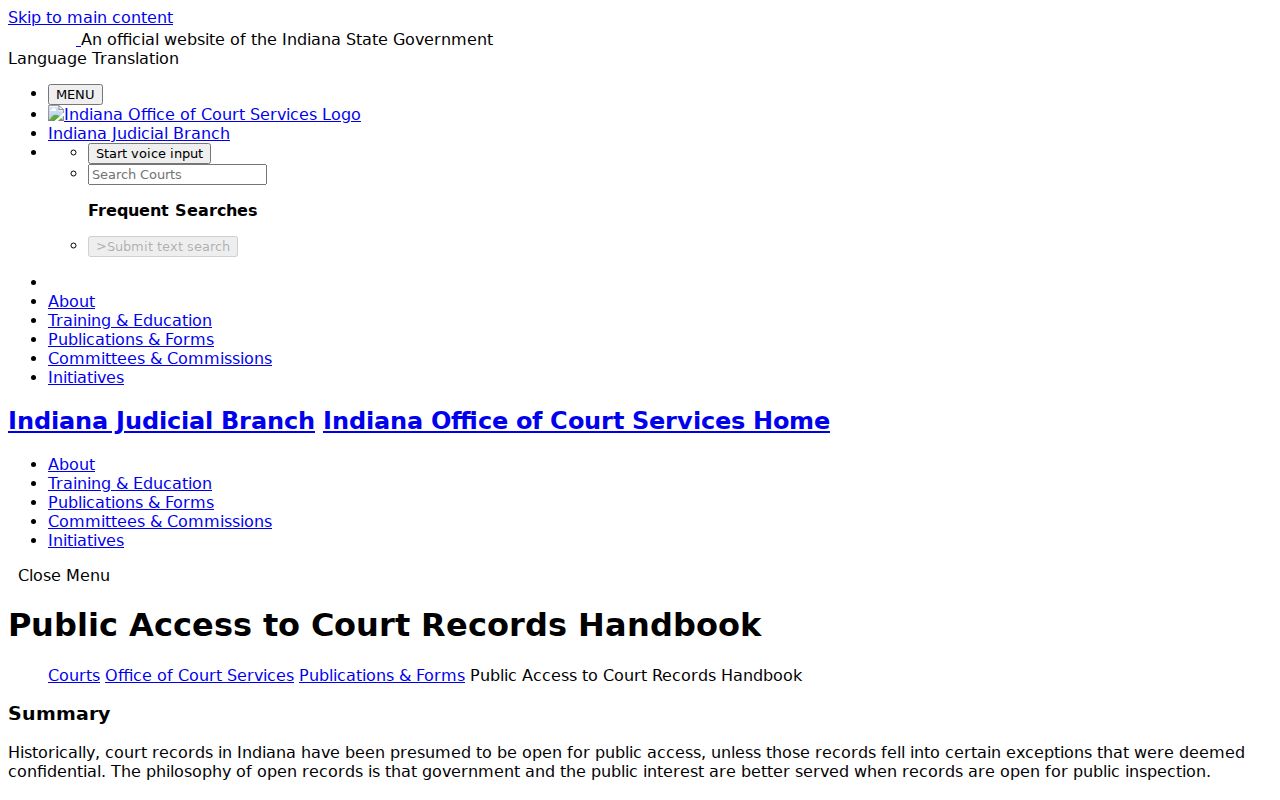
The Indiana public-access handbook spells out the rules on inspection and copying. MyCase itself warns that its display can contain errors or omissions. Treat the online view as orientation. It is not a certified Carroll County court record. Nor is it a guaranteed current balance, or proof that every filing is visible.
Check any entry against the latest CCS events. A document can be superseded, a hearing reset, a balance missing recent activity. When exact wording or legal status matters, request the maintained item and specify the form you need.
Inside a Carroll County Court Record
A public Case Summary often holds enough detail to identify a file and pick a document. The header names the court and core case metadata. Party blocks list public roles. The CCS runs through dated events, and other areas appear only when relevant and public. A criminal-style record may show charges and bonds. A civil record may show judgments or monetary awards.
| Case header | Style, number, court, case type, filed date, status, flags, and related cases |
|---|---|
| Parties and attorneys | Public roles, names, counsel, and removal details when available |
| Chronological Case Summary | Event date, description, comments, hearing result, cancellation, and document links |
| Case-specific blocks | Charges, bonds, judgments, awards, or disposition fields when applicable |
| Financial information | Displayed charges, credits, payments, transactions, and balance as of a date |
Remember that a CCS is the register of actions. It is not the whole evidence file. "Filed" records receipt, not approval. "Order" reflects judicial action. "Closed" says nothing about the result without the disposition or judgment. These plain distinctions keep a database label from being stretched past what it actually says.
Carroll County Document Links
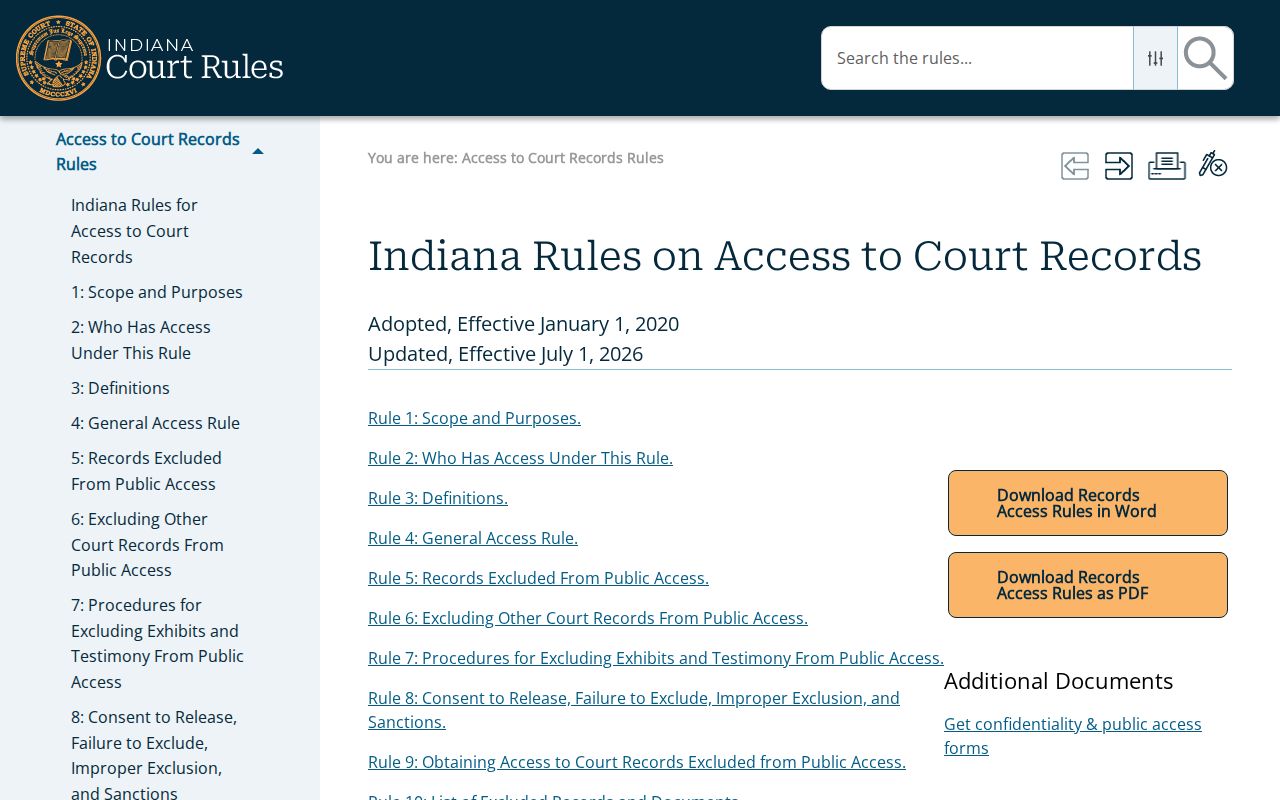
Access is set by the public-access matrix and the Indiana Rules on Access to Court Records. Those rules decide what you may see. Expanding a CCS event can reveal one or more document icons. A missing link has several possible causes. No public image was posted, or the document is excluded. The case may have been converted from an older system. Or the application is temporarily down.
Electronic filing does not make everything public. Attorneys must e-file in Carroll County, and non-attorneys are encouraged to use the statewide process. Confidentiality and redaction rules still apply after submission. When a referenced filing has no public image, contact the clerk.
Fees and Certified Copies
Carroll County posts no single fee schedule covering every copy type, certification, and mailing option. Ask the clerk for the exact amount before you send money. The Indiana ePay traffic charges are not a guide to general court-copy costs. Statewide, inspection time usually costs nothing. But reproduction, certification, postage, and specialized products can carry lawful charges.
| Product | What to confirm | Who handles it |
|---|---|---|
| Inspection | Availability, location, appointment, and format | Clerk or maintaining court |
| Ordinary copy | Page or format charge and delivery cost | Carroll County Clerk |
| Certified copy | Copy fee plus current certification charge | Carroll County Clerk |
| Transcript | Page estimate, minimum, schedule, and rush rate | Court reporter |
Transcripts have set caps in the Carroll local rules. The maximum is $4 per page, with a $35 floor for fewer than ten pages. Rush work can reach $6 per page. Ask the reporter for a current quote, and remember these caps govern transcripts, not ordinary clerk copies.
Older Carroll County Court Files
Older Carroll County court files come in every condition. Some sit on paper. Some were converted. Some are indexed only partly, and some have no public images at all. The clerk can tell you what survives and where it lives. Staff can also say which reproduction formats are realistic. Local rules fix evidence-retention periods by category. There is no one blanket rule for every case file.
For exhibits in certain civil, adoption, paternity, and juvenile matters, the cited rule allows disposal four months after decision when no appeal is pending. Otherwise it allows disposal two years after appeal for the listed category. Serious criminal evidence stays longer. Note the limit: these periods cover identified exhibits. They are not a promise that the whole docket vanishes on the same date.
Preserve the case number, court, event date, and item description before asking about an older Carroll County file.
Sealed Records and Public Access
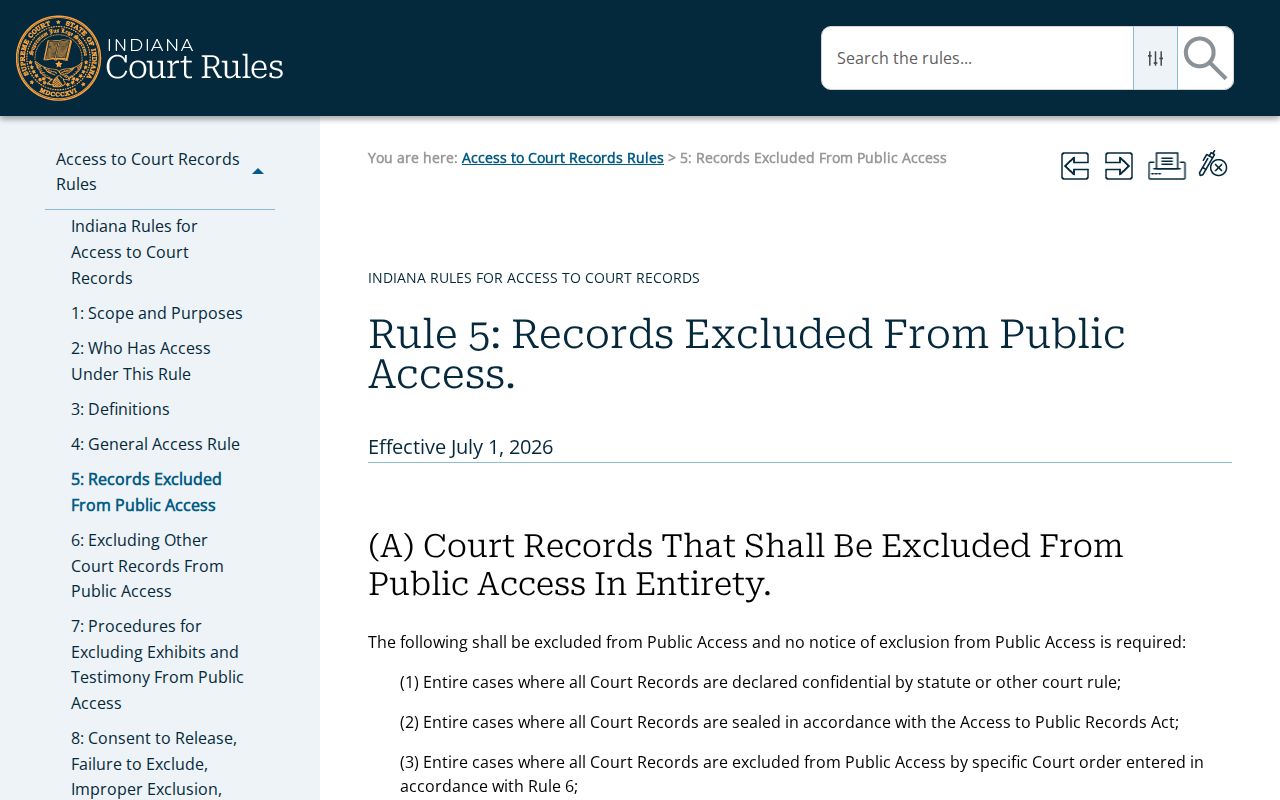
Indiana Access Rule 4 starts from a simple premise. A Court Record is public unless another rule excludes it. Rule 5 then shields whole confidential or sealed cases, plus listed documents and data. The protected list includes mental-health files and privileged in-camera material. It also covers medical or substance-use information, sexual images, parenting reports, and specified personal identifiers. A docket may still show that a filing exists. The protected content stays hidden.
For the authoritative list of exclusions and redactions, read the current Rule 5 text. That rule also spells out handling for Social Security numbers, financial account numbers, passwords, addresses, birth dates, phone numbers, and other sensitive fields.
A document missing from public view does not mean it was never filed. No general records request will open a sealed case. Rule 9 does allow one narrow exception. That exception is a verified court request resting on extraordinary circumstances and public interest, with notice, findings, and possible conditions. That route is not the normal way to buy a copy.
Carroll County Clerk Record Desk
For filings and records in Carroll County, start with Clerk Sharon Milburn. Her desk can confirm whether a copy exists, arrange certification, quote current balances, help with transcripts, and explain a confusing MyCase entry. Staff will not give legal advice or pick your filing strategy. A sharp request names the court, the case number, the case style, a date range, the exact document, the format you want, and whether you need certification.
Carroll County Clerk
101 W. Main St., Suite 206
Delphi, IN 46923
Phone: (765) 564-4485
Monday, Tuesday, Thursday, Friday: 8:00 a.m.–5:00 p.m.
Wednesday: 8:00 a.m.–noon
Indiana's general public-records statute, I.C. § 5-14-3, frames the right to inspect and copy. Its rules bend to exceptions, fees, and a duty to describe records with reasonable particularity. The official statute text lays out all of it.
Court-record access rules still govern what a court can withhold. If you are denied, ask which rule or statute applies and what review is open to you. A precise request beats a broad demand for everything tied to a name.